Millions of people fly every day without giving much thought to the airspace surrounding their aircraft. Whether crossing continents or flying over vast oceans, most passengers assume that every part of the sky belongs to a country. Surprisingly, international law tells a much more complicated story.
While nations have clear authority over the airspace above their territory, there are significant parts of the sky where ownership becomes less obvious. Even more surprisingly, international law has never officially defined where a country’s airspace ends and where outer space begins. These legal grey areas have existed for decades, yet modern aviation continues to operate safely thanks to international cooperation and well-established procedures.
Airspace Ownership at a Glance
| Topic | Current Legal Status |
|---|---|
| Airspace Above National Territory | Owned and controlled by the respective country |
| Airspace Above Territorial Waters | Controlled by the coastal nation |
| Airspace Above International Oceans | Not owned by any country |
| Official Boundary Between Airspace and Space | Not legally defined |
| Commonly Used Kármán Line | 100 km (62 miles) above Earth |
| U.S. Astronaut Recognition Altitude | 80 km (50 miles) above Earth |
| Governing Aviation Agreement | Chicago Convention (1944) |
Countries Control the Air Above Their Territory
Modern aviation is built upon the Chicago Convention of 1944, one of the most important agreements in aviation history. The treaty established a simple but powerful principle: every country has complete and exclusive sovereignty over the airspace above its territory.
This means airlines cannot simply fly wherever they want. Governments control access to their airspace, regulate flights, manage air traffic, and enforce national security requirements. Without this framework, international aviation would be nearly impossible to manage safely. However, the Chicago Convention left one important question unanswered.
Where Does Airspace Actually End?
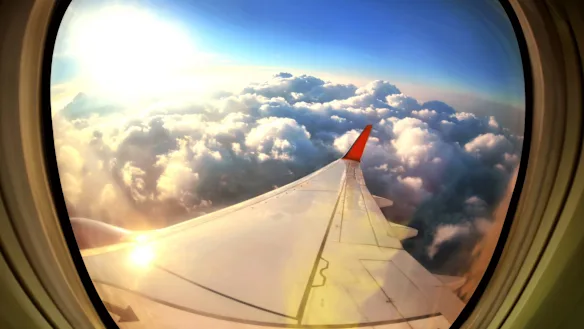
Although countries clearly control the skies above their territory, no international treaty has ever established how far that control extends upward. The convention never defines the altitude at which national airspace ends and outer space begins.
For today’s commercial aircraft, this isn’t a practical problem. Most airliners cruise between 30,000 and 43,000 feet, far below any proposed boundary with space. But as technology advances and companies begin developing suborbital passenger vehicles and reusable spacecraft, the question becomes increasingly important.
The Kármán Line: A Popular But Unofficial Boundary
Many aerospace organizations use the Kármán Line as a practical boundary between Earth’s atmosphere and outer space. Located approximately 100 kilometers (62 miles) above sea level, the line marks the altitude where traditional aerodynamic flight becomes increasingly difficult. Despite its popularity, the Kármán Line is not recognized by any binding international law.
The 1967 Outer Space Treaty states that outer space belongs to everyone and cannot be claimed by any nation. However, the treaty deliberately avoids defining exactly where space begins. As a result, there is still no universally accepted legal border separating sovereign airspace from outer space.
Different Countries Use Different Definitions
The situation becomes even more complicated because not everyone agrees on where space starts. While many international organizations use the 100-kilometer Kármán Line, the United States has historically recognized 80 kilometers (50 miles) as the altitude at which individuals can qualify for astronaut status.
This creates a zone between 80 and 100 kilometers where different interpretations overlap. For now, this legal ambiguity remains largely theoretical, but future space tourism and hypersonic transportation projects may eventually force regulators to establish a clear international boundary.
No Country Owns the Air Above the Open Ocean
The second major legal surprise affects commercial aviation every day. A country’s sovereignty extends over its land territory and territorial waters, which generally stretch 12 nautical miles from its coastline. Beyond that point lies the high seas. Just as no nation owns the open ocean, no nation owns the airspace above it. This means that during long-haul flights across the Atlantic, Pacific, or Indian Oceans, aircraft often spend hours flying through international airspace that belongs to no country.
How International Flights Are Managed
Even though no country owns international airspace, flights are still carefully organized and monitored. The International Civil Aviation Organization (ICAO) divides the world’s skies into Flight Information Regions (FIRs). These regions are assigned to various countries and aviation authorities that provide:
- Air traffic services
- Flight information
- Search and rescue coordination
- Communication support
- Operational guidance
Importantly, managing an FIR does not mean owning it. Countries provide services within these regions, but they do not gain territorial sovereignty over the airspace.
Flying Across the Atlantic
A flight between New York and London provides a perfect example. During departure, the aircraft operates within U.S. airspace. Later, it enters Canadian-controlled regions before eventually reaching international airspace over the Atlantic Ocean.
For several hours, the aircraft may fly through skies that technically belong to no nation. Eventually, it enters European airspace and continues toward its destination. Throughout the journey, air traffic controllers maintain communication and ensure safety, even though the aircraft spends a significant portion of the flight outside any country’s sovereign territory.
Why Aviation Still Works So Well
Despite these unresolved legal questions, international aviation remains one of the safest and most organized transportation systems in the world. The reason is simple: practical cooperation has often moved faster than legal definitions. Airlines, governments, regulators, and aviation organizations have developed systems that allow aircraft to operate safely regardless of who technically owns the sky beneath them. Advanced navigation systems, satellite communications, procedural separation standards, and international agreements ensure that flights can cross oceans and continents every day without incident.
The Future Could Force New Rules
For conventional commercial aviation, the current system works remarkably well. However, the rise of private spaceflight, reusable rockets, high-altitude aircraft, and future hypersonic passenger transportation could eventually expose the legal gaps that have existed for decades.
Questions about where airspace ends, where space begins, and who controls those regions may become increasingly important as aerospace technology continues to evolve. Until then, passengers cruising at 35,000 feet can take comfort in knowing that while the legal status of the sky may be surprisingly complex, the systems keeping them safe are among the most sophisticated ever created.