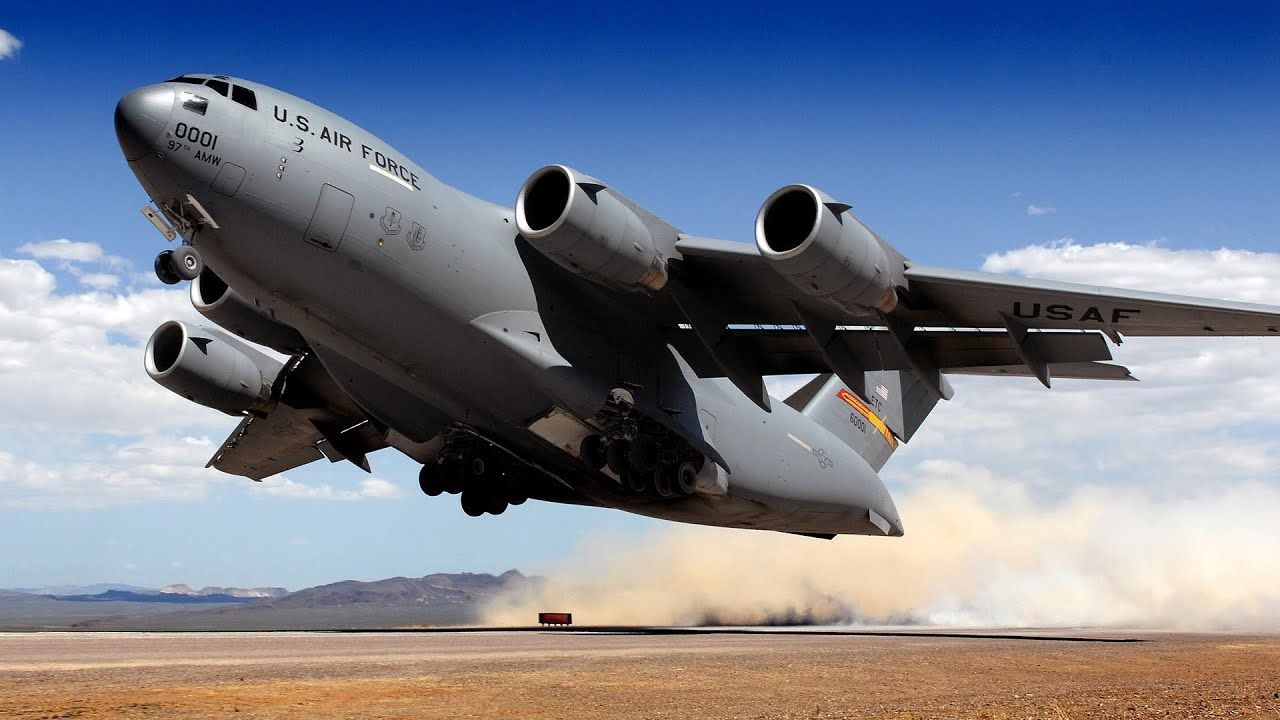
The Boeing C-17 Globemaster III employs an externally blown flap system that enables exceptional short field performance. This propulsive lift configuration directs engine exhaust onto extended wing flaps generating additional lift at low speeds. The design allows the aircraft to land heavy payloads on short runways. However the same system creates distinctive noise characteristics during approach and landing phases. No other operational military transport aircraft produces comparable acoustic signatures.
The C-17 remains the only strategic airlifter utilizing this technology in regular service. Its capabilities support rapid deployment to austere locations worldwide. The noise implications affect operations at joint use airfields and bases near residential communities. Understanding the system mechanics and resulting acoustics helps explain ongoing management challenges.
How the Externally Blown Flap System Functions
The C-17 features four Pratt and Whitney F117 turbofan engines mounted under the wings. When trailing edge flaps extend the exhaust flows directly onto and through double slotted flap surfaces. This interaction redirects exhaust energy downward augmenting wing lift. The configuration produces roughly twice the lift of a conventional transport wing of similar size.
This enables controlled approaches at speeds as low as 150 to 160 knots with maximum gross weights approaching 585 000 pounds. The system proves critical for missions requiring delivery of 160 000 pound payloads to 3 000 foot runways. Conventional high lift systems using slats and flaps alone cannot achieve comparable performance at these weights and speeds.
The flaps work alongside direct lift control spoilers and a robust landing gear designed for rough surfaces. Forward and upward thrust reversers allow the aircraft to back up under its own power. This reduces ramp space needs at forward operating locations. The entire design prioritizes tactical flexibility over conventional transport efficiency.
C-17 Performance Specifications
| Parameter | Value |
|---|---|
| Maximum Gross Weight | 585 000 pounds |
| Maximum Payload | 170 900 pounds |
| Short Field Landing Capability | 3 000 feet with 160 000 pound payload |
| Approach Speed | 150 to 160 knots |
| Engines | Four Pratt and Whitney F117 |
This table summarizes key metrics demonstrating the aircraft unique capabilities. Data reflects standard operating conditions.
Historical Development and NASA Contributions
The externally blown flap concept originated in NASA research during the 1950s. Langley Research Center conducted wind tunnel testing using powered models. The studies demonstrated that directing jet exhaust over flaps could generate substantial additional lift at low speeds. Researchers patented configurations emerging from this work.
The first full scale flight demonstration occurred with the McDonnell Douglas YC-15 in the 1970s. This experimental short takeoff and landing transport validated the concept for jet powered aircraft. Although the Advanced Medium STOL Transport program did not lead to production the aerodynamic foundation proved valuable. McDonnell Douglas drew upon YC-15 data when designing the C-17 for the C-X competition.
Multiple NASA centers contributed to C-17 development. Langley provided foundational blown flap aerodynamics. Ames handled additional testing. Lewis Research Center supported propulsion integration. Dryden assisted with flight testing after the first flight in 1991. The technology benefited from roughly 35 years of research before the C-17 entered service in 1995.
Sources of Landing Noise
Conventional transport aircraft generate approach noise from engines at reduced power and aerodynamic sources including landing gear slats and flap edges. The C-17 adds a significant jet flap interaction component. High velocity exhaust impacting flap surfaces and redirecting downward creates broadband noise across wide frequencies.
The noise intensity scales with exhaust velocity and flap surface area. On the C-17 large flaps and high exhaust velocity amplify this effect. The interaction occurs across engine pairs with noise radiating primarily downward and behind the aircraft. This directs sound toward the ground during low altitude approach phases when flaps are fully extended.
The resulting footprint differs in character and intensity from other aircraft of similar size. A C-5 Galaxy produces conventional engine and airframe noise. The C-17 layers jet flap interaction atop those sources. This creates unique challenges at shared use airfields near populated areas.
Measurement and Mitigation Efforts
NASA conducted dedicated noise studies at Edwards Air Force Base in 2005. Researchers recorded acoustic data during various approach profiles. Students from California Polytechnic collected measurements using ground equipment. The tests mapped how changes in altitude speed and flap settings affected ground noise.
These efforts formed part of broader NASA work on military aircraft noise at joint use facilities. Bases like Charleston Joint Base Lewis McChord and March Air Reserve Base operate C-17s near residential communities. Operational adjustments rather than structural changes provide primary noise reduction methods.
Steeper approach angles reduce low altitude exposure time. Higher speeds with reduced flap deflection decrease exhaust interaction but also reduce lift benefits. These trade offs require careful balancing. The configuration delivering maximum short field performance also produces peak noise levels.
Operational Context and Community Impact
The C-17 operates from joint civil military airports and bases adjacent to residential areas. Its noise signature raises practical concerns at these locations. The United States Air Force manages 223 C-17s across 12 domestic bases. International operators include the United Kingdom Australia Canada and others.
The aircraft requires a crew of three consisting of two pilots and one loadmaster. No replacement program exists with operations expected through the 2040s. The combination of unique capabilities and acoustic characteristics shapes how the Air Force plans missions and engages communities.
Noise management involves procedural adjustments community outreach and ongoing research. The distinctive sound profile becomes familiar at regular operating locations. Newer bases or joint use facilities require additional coordination. The capability trade off remains central to C-17 employment.
Further Considerations for Noise Management
As the C-17 fleet ages operational patterns may evolve. Potential engine or flap modifications could influence noise characteristics though no major upgrades are currently planned. Continued research into approach procedures and community engagement remains important. The aircraft unique design ensures its acoustic signature will remain distinctive.
The C-17 demonstrates successful integration of propulsive lift technology. Its capabilities support critical military airlift requirements worldwide. Managing the associated noise challenges represents an ongoing operational reality. The balance between performance and community impact defines how the Globemaster serves its mission.
In summary the C-17 Globemaster externally blown flap system enables unmatched short field performance. This design creates landing noise profiles distinct from other military transports. NASA research and operational experience inform current management approaches. The aircraft continues fulfilling strategic airlift roles while addressing acoustic considerations at operating locations.