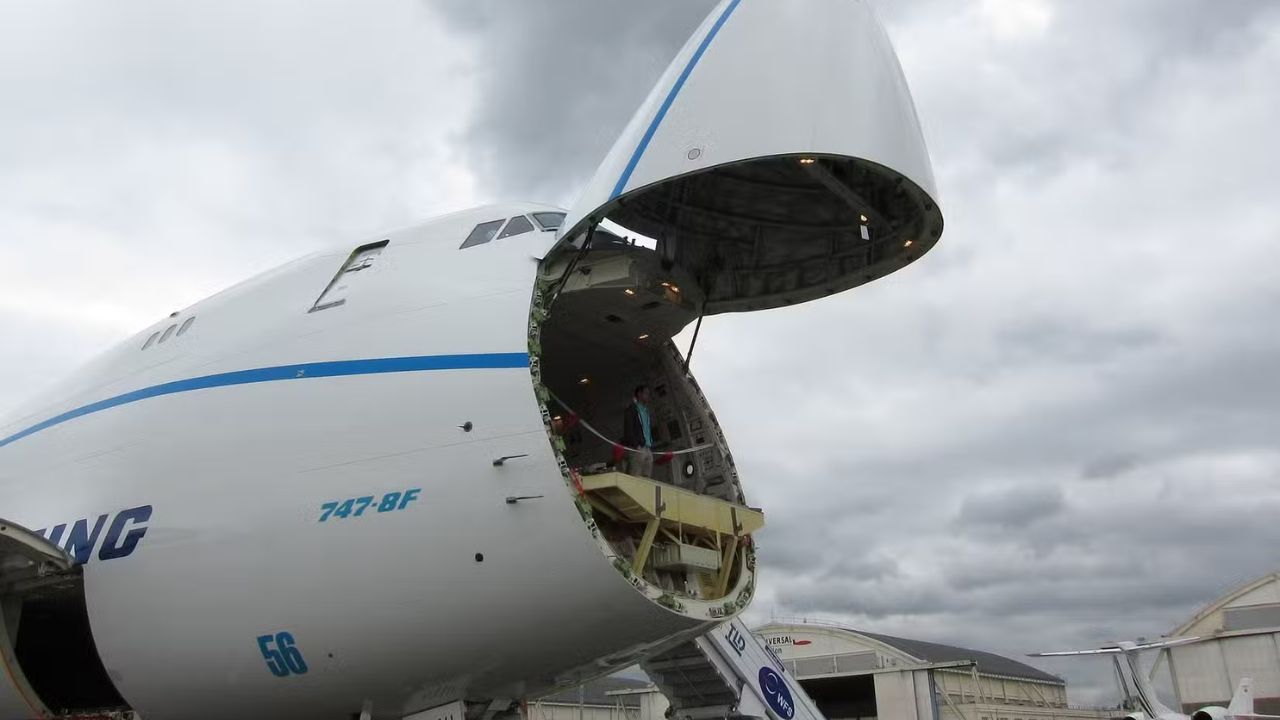
The Boeing 747 freighter occupies a unique position in aviation history as one of the most capable and recognizable cargo aircraft ever built. Its most distinctive feature remains the upward-swinging nose door. This capability sets it apart from virtually every other large freighter in commercial service. The design enables the straight-in loading of exceptionally long, bulky, or awkward cargo items that would prove impossible or inefficient through conventional side doors.
Boeing engineers incorporated this nose door from the earliest conceptual stages of the 747 program in the 1960s. At that time, the company was responding to a US Air Force request for a large military transport under the CX-HLS program while also anticipating the rise of supersonic passenger travel. Planners initially viewed the 747 as a potential interim solution that might transition primarily to freighter duties once supersonic transports dominated long-haul routes. This foresight shaped fundamental design choices.
Origins of the Iconic Hump and Nose Door
Boeing faced a core engineering challenge when designing a nose-loading freighter. Placing a large cargo door at the front required relocating the flight deck. Traditional cockpit placement at the nose would obstruct direct access to the main cargo hold. The solution involved raising the cockpit to a partial upper deck, creating the aircraft’s famous hump. This configuration allowed the entire nose section forward of the cockpit to hinge upward, providing unobstructed straight-through access to the main deck.
Joe Sutter and his team finalized this layout after earlier full double-deck concepts proved impractical due to evacuation and structural concerns. The raised cockpit not only facilitated the nose door but also produced additional space behind the flight deck that later became premium passenger lounges in early airliner variants. The hump thus served dual purposes from the start, supporting both potential passenger luxury and essential freighter functionality.
Factory-built 747 freighters, including the -100F, -200F, -400F, and -8F models, feature this nose door as standard equipment. Most modern 747 freighters in service began life as passenger aircraft and underwent conversion. These conversions typically do not include the full nose door structure, which requires specific forward fuselage reinforcements absent in passenger models. Only purpose-built freighters retain the complete nose-loading system.
Technical Details of the Nose Door Operation
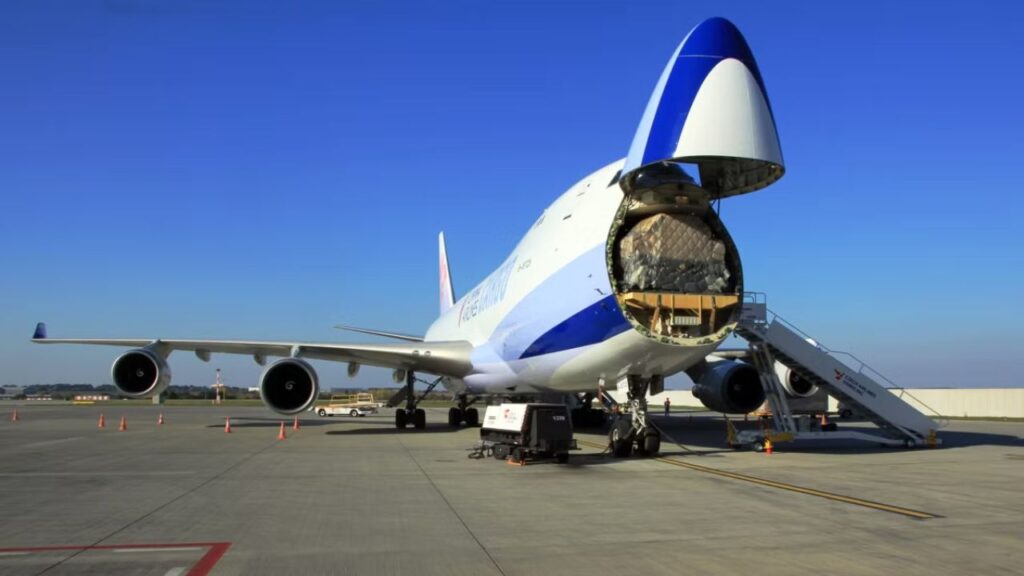
The nose door system represents sophisticated mechanical engineering. The door attaches to the fuselage via two large upper hinges. An electric motor, located in the nose cone, powers the opening and closing through flexible shafts connected to gearboxes and dual screw jacks. This fully mechanical setup, rather than hydraulic, ensures operation even without engine power or hydraulic pressure at remote airfields.
Operators control the system from a dedicated panel near the nose. This panel includes indicators for the 16 heavy-duty latches that secure the door in flight. Each latch uses a pin mechanism driven by small electric actuators to lock firmly. The process involves the motor driving the screw jacks to swing the nose upward and outward, clearing the main deck floor for loading. Closing reverses the sequence, with latches engaging to seal the structure aerodynamically.
This design permits loading of pallets or containers up to approximately 40 feet long directly on powered rollers in the main deck. Overall, the system supports cargo up to 185 feet (56.4 meters) in length when items extend through the hold, along with widths up to 12.5 feet (3.8 meters). Height and other dimensional limits vary by specific loading configuration and aircraft variant. Ground crews must carefully assess cargo dimensions against side door capabilities before opting for nose loading.
The nose door excels particularly with outsized items such as aircraft wings, large industrial machinery, mining equipment, generators, or construction components. These loads benefit from straight alignment without the need to pivot around a side door frame, reducing handling risks and enabling more efficient loading of long items.
Operational Advantages for Cargo Carriers
Cargo airlines continue to value the 747 freighter for its versatility beyond just the nose door. The aircraft offers substantial main deck, upper deck, and belly hold capacity. The -400F typically handles around 120 tonnes of payload, while the larger -8F increases this to approximately 140 tonnes. This distributed capacity across decks supports a wide range of cargo mixes.
Boeing 747-400F and 747-8F Key Specifications Comparison
| Specification | 747-400F | 747-8F |
|---|---|---|
| Length | 231 ft 11 in (70.70 m) | 250 ft 2 in (76.25 m) |
| Wingspan | 211 ft 5 in (64.44 m) | 224 ft 7 in (68.45 m) |
| Height | 63 ft 8 in (19.41 m) | 63 ft 6 in (19.35 m) |
| MTOW | 875,000 lbs (396,900 kg) | 988,000 lbs (448,000 kg) |
| Payload | 264,554 lbs (120 t) | 308,000 lbs (140 t) |
| Range | 4,444 nm (8,230 km) | 4,390 nm (8,130 km) |
| Cruise Speed | M0.845 | M0.845 |
The -8F provides additional advantages through its stretched fuselage, larger wing, and more efficient General Electric GEnx engines, which deliver about 17 percent lower fuel consumption compared to the -400F. These improvements enhance economics on high-utilization routes despite a slightly shorter range in some configurations. Both variants maintain similar cruise speeds.
Cargo operators often prefer pre-owned aircraft due to lower acquisition costs, suiting variable utilization patterns. Newer or factory-fresh examples typically fly dense, high-frequency routes such as transpacific services. Since Boeing ended 747 production in 2022, with the final aircraft delivered as a freighter to Atlas Air, conversions of retiring passenger models represent the primary way to refresh freighter fleets.
Major Operators and Fleet Status
Atlas Air stands as the world’s largest 747 freighter operator. The carrier maintains a significant fleet that includes both -400F and -8F variants. Other prominent operators include UPS Airlines, Cargolux, Kalitta Air, and Cathay Pacific. These airlines leverage the 747’s capabilities for global cargo networks, particularly for oversized or time-sensitive shipments.
As of recent data in 2026, hundreds of 747 freighters remain active worldwide. The type continues to form a substantial portion of the widebody freighter fleet despite the end of production. Passenger operations have largely concluded, with only a handful of airlines such as Lufthansa, Korean Air, and Air China retaining small numbers for premium or specific routes.
The 747’s longevity in cargo service stems from its unmatched combination of payload, range, and unique loading features. While newer twin-engine freighters like the Boeing 777F offer efficiency gains, they lack the nose door and overall volume for certain outsized cargoes that the 747 handles routinely.
Enduring Impact on Air Cargo
The nose door was never merely an add-on feature. It embodied Boeing’s forward-thinking approach to aircraft design that balanced anticipated market shifts with practical utility. What began as a hedge against supersonic futures evolved into one of the most successful widebody platforms in history, with over 1,570 aircraft delivered across all variants.
Today, the upward-hinging nose remains a powerful symbol of the 747’s engineering ingenuity. It enables cargo airlines to move goods that would otherwise require specialized surface transport or disassembly. This capability has supported industries ranging from aerospace manufacturing to energy and construction projects globally.
The 747 freighter’s nose door thus represents more than a technical solution. It stands as a testament to innovative design that anticipated real-world operational needs. Even decades after its first flight in 1969, the aircraft continues to prove its worth in an evolving air cargo landscape, carrying the distinctive hump and functional nose that define its legacy.